
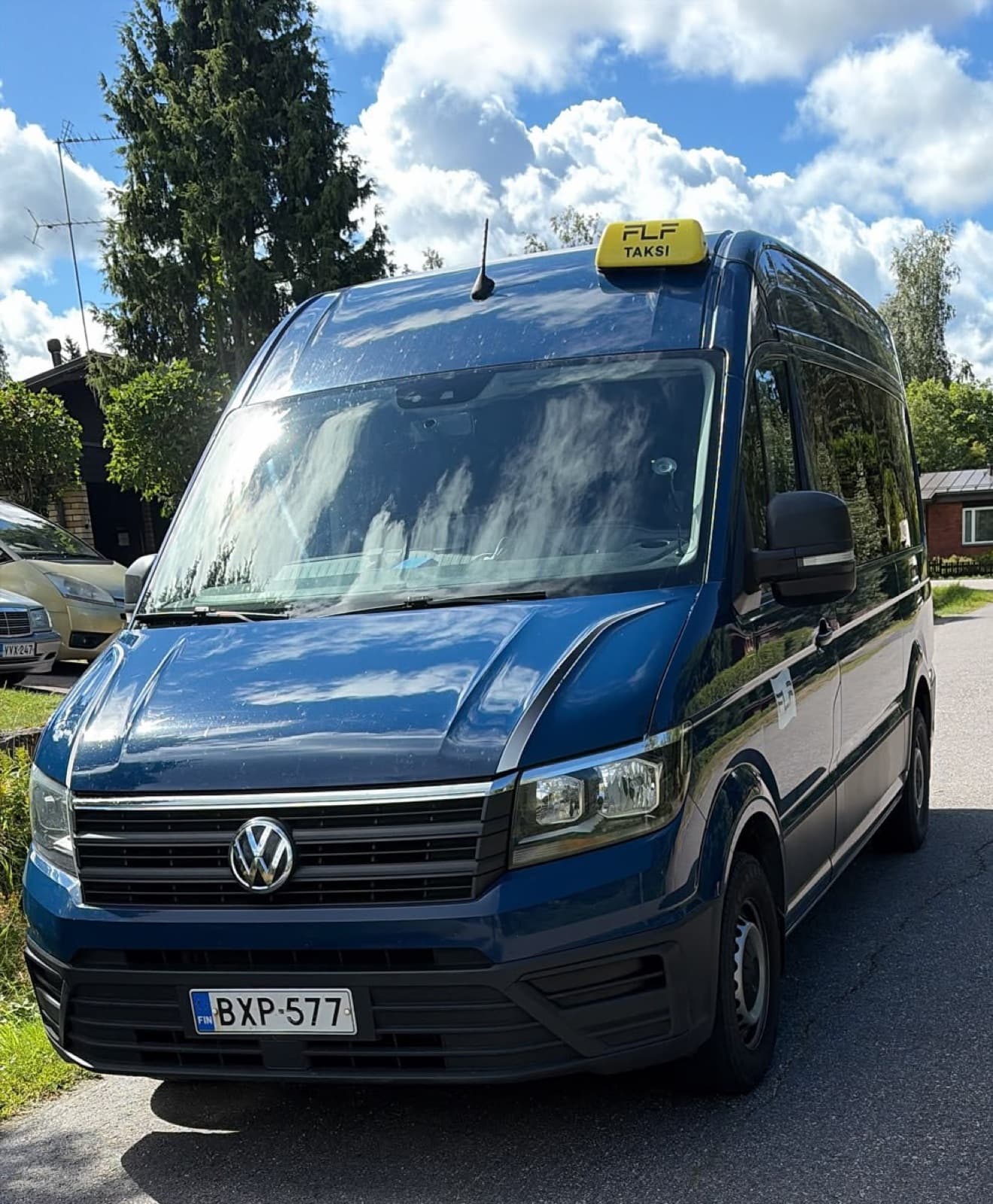
FLF Staff transport
Staff and shift transport for employees
Regular contract transport for shift changes, terminals and work sites. The standing timetable is agreed once, so no booking is needed for each departure.
Staff and shift transport is contract work, not a series of single rides. The point is that the same group travels at the same times week after week and the transport runs without a separate booking for each departure. This page covers who it suits, how timetables and changes are agreed and how many people fit in one vehicle. We run staff transport across Päijät-Häme, Kanta-Häme and Uusimaa, and our taxi office is in Lahti on Asentajankatu.
The typical case is a shift change at an hour when public transport does not run, or a workplace with no sensible public transport link at all. Transport is agreed as a standing timetable: departure points, times, weekdays and passengers are recorded once, and the vehicles run accordingly. Changes and absences are reported to a named contact person. Starting a new service always begins with a quote request by phone or email, not through a booking app.
The price comes from the route, the time of day, the weekday, the number of vehicles and the length of the agreement. Regular runs are usually priced as a fixed fare per shift or departure, because a vehicle and a driver are reserved for a specific time. Nights, weekends and public holidays are priced separately. We do not publish prices, because every timetable is different. Business prices are quoted excluding VAT, and passenger transport carries 14 % VAT. A quote usually arrives the same working day.
1+8
passengers per minivan taxi
30+
vehicles to cover shifts
7 days
agreed runs including nights and weekends
20 min
Lahti to Nastola, about 20 km
Who staff transport suits
The need usually comes from the hour, the location or the size of the group. These are the most common cases in our area.
Industry and shift work
Three-shift changeovers fall at hours when no bus runs. Agreed transport makes sure the shift starts with a full crew.
Logistics centres and terminals
Warehouse and terminal work often starts before six in the morning and ends at night. Transport runs to the gate, not to the nearest stop.
Care and health sector
Morning and night changeovers at care homes and treatment units. One vehicle can call at several units on the same round when needed.
Work sites
A site moves with the project, and transport is redirected to the new address without a new agreement. Tools and kit fit in a minivan taxi.
Seasonal work
Fixed-term transport for a season, a stocktake or a production peak, when setting something up in-house makes no sense for a few weeks.
Why a taxi rather than a private car or a coach
Shift changes are the most common reason. When a shift starts at five in the morning or ends at half past midnight, public transport is no help, and relying on private cars means an employee effectively has to own one to hold the job. That quickly becomes a recruitment question: a candidate without a car does not send the application. Agreed transport widens the area from which it is realistic to hire.
The second reason is group size. A coach pays off when passengers number in the dozens, but for a group of six or eight it is too big and too expensive to move. A minivan taxi carries 1+8 passengers, and a larger group gets several vehicles on the same departure. We do not run coaches for more than eight passengers, so we tell you plainly how many vehicles the timetable needs and what that costs.
The third reason is a location that moves. A site changes address, production shifts to another hall or a project ends. A taxi agreement can be redirected and ended without the company buying vehicles or committing to a long coach contract. Our drivers are our own employees and we run driver training ourselves, so covering absences across shifts is our problem, not yours.
How shifts and timetables are agreed
The standing timetable is the core of the agreement. Once it is recorded, the service runs without daily booking.
- The standing timetable is recorded once: departure points, times, weekdays and passengers. No booking is needed per shift.
- Pick-up happens from one meeting point or as a round through several addresses. The order of the round is planned so that even the last passenger arrives on time.
- The same shift is driven by the same driver or a small driver group, so the route, gates and access permits are familiar.
- Changes are reported to your contact person. The agreement sets how far before departure a cancellation or timetable change must be given, so the vehicle can be redirected.
- One passenger's absence does not cancel the shift: the vehicle runs as agreed for the others, and telling us saves a pointless pick-up stop.
- Public holidays, shutdowns and holiday weeks are entered in the calendar in advance, so we know when there is no run.
Capacity and fleet
The number of vehicles follows from the passenger count and where the pick-up points sit. These are the practical limits.
- One minivan taxi carries 1+8 passengers. The minivan fleet is the Mercedes-Benz Sprinter, Volkswagen Crafter and VW Caddy Maxi.
- A group of more than eight is split between several vehicles that leave at the same time and arrive together.
- If a shift includes an employee who uses a wheelchair, an accessible minivan handles the same run, so no separate arrangement is needed.
- Saloon cars suit shifts with one or two passengers, for example individual night changeovers.
- A large share of the fleet is electric or hybrid, which helps if you report commuting emissions.
- A fleet of more than 30 vehicles means several shifts from different addresses on the same morning can run in parallel.
Employment areas and routes in Päijät-Häme
Commuting around Lahti concentrates on a few directions, and that shows in the transport requests we receive. Nastola was merged into Lahti in 2016 and is now a district about 20 km east of the centre, roughly a 20-minute drive. Villähde, Uusikylä and the area around Nastola station are typical pick-up points, and there is plenty of morning-shift traffic to production plants in the area.
Hollola is Lahti's neighbour to the west, about 10 km and 15 minutes from the centre. The Salpakangas centre, Hälvälä and Kukkila are regular directions. The Lahti harbour and Teivaanmäki area sits a short drive from the centre, so a morning round through several pick-up points is genuinely possible with one vehicle if the departure times are planned properly.
A practical tip for your quote request: as well as the addresses, give the time by which passengers must be on site, not the time you would like the vehicle to leave. The departure time is easy to calculate once arrival is fixed, and it also shows whether one more pick-up point fits on the round. Tell us too whether the vehicle can drive through the gate and whether an access permit is needed, because that decides where passengers are dropped.
Costs and taxation
Regular transport is usually priced as a fixed fare per shift or departure, because a vehicle and a driver are reserved for a set time. With several passengers in the same vehicle, the cost per passenger falls clearly compared with everyone travelling separately. All shifts are collected onto one monthly invoice, and rides can be coded to a department, a shift or a site depending on how you want the cost split.
The tax treatment of employer-arranged transport depends on the situation: some arrangements are a taxable benefit for the employee and some are not, and the answer turns on matters such as the nature of the journey and how the transport is organised. We do not give tax advice. Check it with your accountant or accounting firm before the service becomes permanent, so payroll knows how to handle the benefit. Our part is to supply an invoice breakdown as detailed as that decision requires.
How the service starts
- 01
Send the timetable
Give us the shift times, pick-up points and passenger count, plus the time by which those in the vehicle must be on site.
- 02
We plan the route and vehicles
We work out how many vehicles the timetable needs and in what order the pick-ups should run. Where it helps, we suggest a small shift in departure time if that saves a vehicle.
- 03
Quote and agreement
You receive a fixed price per shift and a draft agreement covering notice periods for changes, invoicing and contact persons on both sides.
- 04
Start-up and fine-tuning
The first weeks run as agreed, after which we review whether the times land correctly. A small change to the pick-up order often fixes congestion.
Pricing
The price comes from the route, the time of day, the weekday, the number of vehicles and the length of the agreement. Nights, weekends and public holidays are priced separately. Prices are quoted excluding VAT; passenger transport carries 14 % VAT.
Fixed shift price
A price per departure agreed for the standing timetable. The same amount every time regardless of passenger count or traffic.
Round price for several pick-ups
When a vehicle calls at several addresses, the price is agreed for the whole round rather than per pick-up point.
Fixed-term project price
A price agreed for a defined period covering seasonal work, a shutdown or a site, after which the service ends as set out in the agreement.
Request a staff transport quote
Send the shift times and pick-up points and we will tell you how many vehicles the timetable needs and what it costs. A quote usually arrives the same working day.
Frequently asked questions
What does staff transport cost?
The price comes from the route, the time of day, the weekday, the number of vehicles, the passenger count and the length of the agreement. Regular runs are usually priced as a fixed fare per shift, so the amount is the same every time. Nights, weekends and public holidays are priced separately. We do not publish prices, because every timetable differs. Send the shift times and pick-up points and you will usually have a quote the same working day.
How small a group makes transport worthwhile?
Two or three passengers can already be enough, if the alternative is everyone travelling separately or a shift starting short-handed. The cost per passenger drops as soon as a second person shares the vehicle, and the ceiling for a minivan taxi is eight passengers. A coach only pays off in the dozens, and we do not run vehicles for more than eight. Tell us the passenger count and we will cost the options.
Do you cover night shifts and weekends?
Yes, when the times are agreed in the contract in advance. Agreed shifts run at night, at weekends and on public holidays, because those are exactly the hours when public transport is missing. Night, weekend and holiday runs are priced separately. Book the slot into the agreement as early as possible so the same driver can be assigned. We do not dispatch individual on-call rides without a prior agreement.
Is it the same driver every time?
The aim is for the same shift to be driven by the same driver or a small named driver group. Our drivers are our own employees and we train them ourselves, so the route, gates, access permits and passengers are familiar. Annual leave, sick leave and shift rotas are handled by us, so briefing a stand-in is not your work. We tell you in advance if the regular driver changes for a longer period.
How are changes and cancellations handled?
Changes are reported to a named contact person, and the agreement sets how far before departure notice is needed. One passenger's absence does not cancel the shift, but telling us saves a pointless pick-up stop and keeps the timetable. Permanent changes, such as a new pick-up point or a moved shift time, are updated into the standing timetable and need no repeat booking.
Is employer-arranged transport a taxable benefit?
It depends on the situation, and there is no single answer. The treatment of employer-arranged transport varies with the nature of the journey and how the transport is organised, and some arrangements are a taxable benefit for the employee. We do not give tax advice. Check it with your accountant or accounting firm before the service starts, so payroll knows how to handle it.
Send the shift times, we will count the vehicles
Call our taxi office in Lahti or email the timetable. We will propose the route, the number of vehicles and a fixed price per shift.